
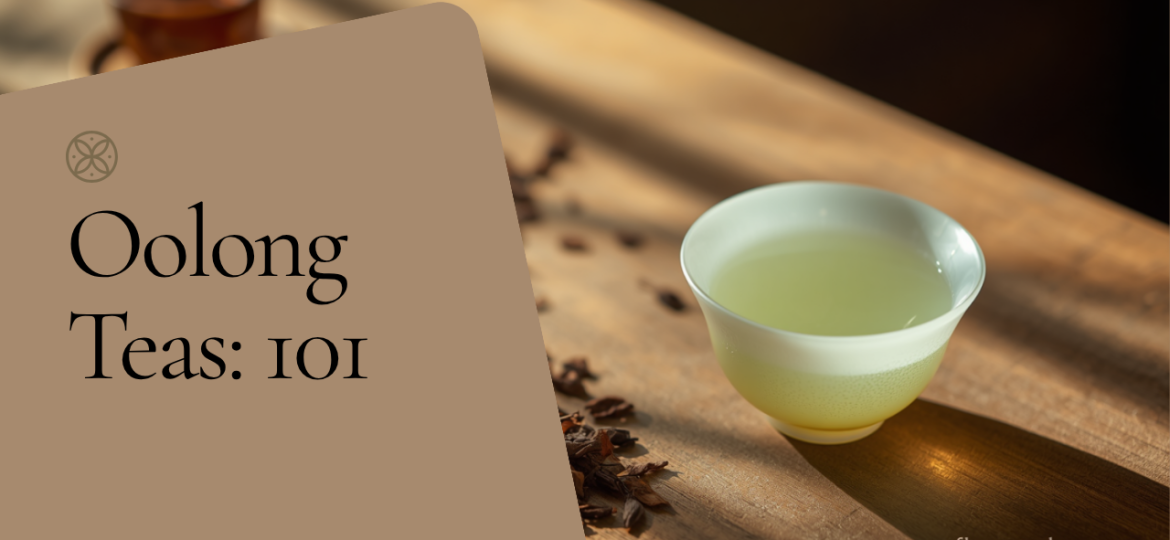
Oolong Tea 101: The Full Spectrum of Types, Oxidation Levels, and How to Brew Each One
Oolong tea is not one tea but an entire spectrum, defined by an oxidation range that runs from roughly 8 percent to as high as 85 percent — a decision made leaf by leaf, by hand, by an artisan reading humidity, aroma, and leaf temperature rather than a clock. That range is why a jade-green Anxi Tieguanyin and a nearly black, charcoal-roasted Wuyi Da Hong Pao are both correctly called oolong tea, despite tasting like they came from different plants entirely. Knowing where a given oolong sits on that spectrum is the fastest way to buy it, brew it, and actually understand what’s in the cup.
I keep four gaiwans going every time I run an oolong tasting for new clients in Oakville, because no single cup can make the point I’m trying to make. Pour a lightly oxidized Anxi Tieguanyin next to a heavily roasted Wuyi Yancha and most people assume I’ve handed them two unrelated teas — one green, one closer to black. They’re both oolong. The category doesn’t describe a fixed flavor or a fixed color; it describes a method, and that method has room inside it for nearly the entire range of what tea can taste like. Most educational content collapses oolong into “somewhere between green and black tea,” which is technically true and almost useless. The real story is in the oxidation percentage, the cultivar, and the region, and once you understand how those three variables interact, you stop guessing at oolong and start reading it.
The Only Definition of Oolong Tea That Actually Holds Up
Every tea — green, white, black, oolong — comes from the same plant, Camellia sinensis. What separates the categories is what happens to the leaf between picking and drying, specifically how much oxidation the leaf undergoes before that oxidation is halted by heat. Green tea is fixed almost immediately, so oxidation barely begins. Black tea is left to oxidize fully, often past 90 percent. Oolong tea occupies the wide territory in between, and “wide” is not an exaggeration: a fragrant, modern-style Tieguanyin might sit at 15 to 20 percent oxidation, while a traditional Dan Cong or a Wuyi rock tea can push past 60 percent. Both are unmistakably oolong tea. Both are made using the technique that actually defines the category: not a fixed oxidation midpoint, but a controlled, partial one, shaped by hand-rolling, tossing, and resting the leaf across many hours rather than minutes.
This is the detail that most tea content gets wrong, and it matters because it changes how you should shop. If someone tells you oolong tea is “half-fermented,” ask them half of what — because a 15 percent oolong and a 70 percent oolong have almost nothing in common on the palate. One is closer in character to a good green tea. The other drinks like a smooth, fruit-toned black tea. Both are correctly labeled oolong tea because both are made using the same core process: withering, bruising the leaf edges to encourage partial oxidation while the leaf center stays green, then arresting that oxidation at a moment the tea master judges by smell and touch rather than by any fixed formula.
What Oxidation Actually Does Inside the Leaf
The chemistry behind that judgment call is worth sitting with, because it explains almost every flavor difference you’ll taste across the category. Fresh tea leaf is rich in catechins — the bitter, astringent polyphenols responsible for a green tea’s sharp, vegetal edge. When a leaf is bruised during the tossing and shaking stage of oolong processing (a step called yao qing in Chinese production, done in bamboo trays or rotating drums), the leaf’s cell walls rupture just enough to expose those catechins to polyphenol oxidase, an enzyme sitting in a separate compartment of the same cell. The enzyme converts catechins into a family of compounds unique to partially oxidized tea called theasinensins — chemical cousins of the theaflavins that define black tea, but structurally distinct, and part of why oolong tea has a flavor signature that neither green nor black tea can replicate.
The aroma tells the same story from a different angle. As oxidation proceeds, the leaf begins producing volatile compounds it didn’t have in its fresh state: linalool and its oxides (the source of oolong’s characteristic floral lift), jasmine lactone, methyl jasmonate, nerolidol, and indole — the same compound, in smaller concentration, that gives jasmine flowers their heady, slightly animalic note at night. A lightly oxidized oolong tea captures these aromatics at their most delicate. Push oxidation further, and roasting begins to layer in Maillard-reaction compounds (the same browning chemistry at work in toasted bread or a well-seared steak), which is why a heavily oxidized, charcoal-finished oolong tea can taste like dried fruit, cocoa, and warm stone rather than orchids. None of this is incidental. Every oolong producer is making a series of deliberate chemical decisions, and the finished character of the tea in your cup is the direct record of those decisions.
Reading the Spectrum, Region by Region
Anxi County in Fujian province is where modern oolong tea as most people know it took shape, and it’s the home of Tieguanyin — Iron Goddess of Mercy — the cultivar carried at Fleur Palace as our Ti Kuan Yin Oolong. The tea gets its name from a Qing-dynasty legend about a devout farmer named Wei Yin who dreamed that the bodhisattva Guanyin led him to a tea bush growing in a rock crevice; whether or not you take the story literally, the cultivar that grew from it became one of the most widely cultivated oolong varietals in the world. Contemporary Anxi Tieguanyin has shifted toward a lighter style over the past few decades (often oxidized in the 15 to 25 percent range and finished with minimal roasting), which produces the bright, orchid-and-lily fragrance and pale jade liquor most drinkers now associate with the name. It is, in a real sense, the most “green” expression of oolong tea you’ll encounter, and it’s the right entry point for anyone who finds black tea too heavy and green tea too austere.
Travel roughly 250 kilometers north into the Wuyi Mountains and the profile changes entirely. Wuyi Yancha — rock tea — includes Da Hong Pao, Shui Jin Gui, Bai Ji Guan, and Tie Luo Han, all grown in the mineral-rich, weathered volcanic soil of the Wuyi cliffs. These teas are oxidized far more heavily, often in the 50 to 70 percent range, and then charcoal-roasted, sometimes over multiple sessions spread across weeks. Growers describe the resulting mineral, almost smoky depth as yan yun, or rock rhyme, a quality tied specifically to the terroir of the Wuyi cliffs and nearly impossible to replicate outside that soil. A Wuyi oolong tea is the closest the category gets to black tea in body, but it retains a structural clarity: you can taste the mineral finish distinct from the fruit notes distinct from the roast, a layering that fully oxidized black tea rarely offers.
Guangdong’s Phoenix Mountain, home to Dan Cong oolong, tells a third story. Dan Cong means “single bush,” and traditional Dan Cong is processed from individual, often centuries-old tea trees rather than blended plantation leaf, which is why the category is organized around aroma names rather than oxidation percentage alone — Mi Lan Xiang (honey orchid), Gui Hua Xiang (osmanthus), Zhi Lan Xiang (orchid). Moderately oxidized, typically in the 30 to 50 percent range, Dan Cong sits between Tieguanyin’s floral lightness and Wuyi’s mineral density, delivering an intensity of natural fruit and flower aroma that most drinkers assume must come from flavoring, and doesn’t.
Then there’s Taiwan, where oolong tea took the technique brought over by Fujianese immigrants in the nineteenth century and pushed it uphill — literally. High-mountain oolong from regions like Alishan and Lishan, grown above 1,000 meters, benefits from the same mechanism that makes high-altitude wine grapes more concentrated: cooler temperatures slow the plant’s growth, thickening the leaf and intensifying its aromatic compounds while UV exposure at altitude boosts amino acid production, which softens bitterness and deepens sweetness. Alishan oolong tea, typically oxidized in a light-to-moderate 20 to 30 percent range and only lightly roasted, delivers a buttery, orchid-forward cup with a long, sweet finish that Taiwanese producers consider the benchmark for the entire high-mountain category.
Milk Oolong and the Chemistry Behind a Tea That Tastes Like Cream
No conversation about Taiwanese oolong tea is complete without addressing Jin Xuan, sold widely (and often inaccurately) as “milk oolong.” Jin Xuan is a genuine cultivar, officially Taiwan Tea Cultivar No. 12, bred in the 1980s specifically for a naturally creamy character. Grown at moderate-to-high altitude and lightly to moderately oxidized, authentic Jin Xuan develops naturally occurring lactones, the same class of aromatic compound responsible for the creamy note in coconut and stone fruit, as a genuine metabolic response to altitude and processing rather than any dairy additive. The confusion arises because a portion of the commercial “milk oolong” sold internationally is standard oolong tea sprayed or tumbled with artificial milk flavoring to imitate what Jin Xuan does on its own. A tea sommelier can usually tell the difference within the first two infusions: authentic Jin Xuan’s creaminess fades naturally and is joined by a vegetal, slightly buttery sweetness across re-steeps, while flavored versions taste artificially flat and lose their “milk” character abruptly after the first pour — the coating, not the leaf, was producing it.
Brewing Each Style the Way Its Terroir Demands
Because oolong tea spans such a wide oxidation range, treating every oolong with the same water temperature and steep time is the single most common way to ruin a good one. Lightly oxidized styles like Anxi Tieguanyin and Alishan high-mountain oolong are best brewed at 85 to 90°C, closer to a good green tea than a black one, because higher heat scorches their delicate floral aromatics and pulls out excess bitterness the leaf was never processed to withstand. Moderately oxidized styles, including most Dan Cong and our Oolong Peach Tea, tolerate slightly hotter water, in the 90 to 95°C range, which helps unlock their fruit-forward volatiles without stripping the tea’s structure. Heavily oxidized, roasted styles like Wuyi Yancha want water at a full boil, 95 to 100°C, because their roasted, mineral compounds need that heat to release fully — the same tea brewed too cool tastes thin and flat rather than layered.
The gongfu method (small vessel, high leaf ratio, short and repeated infusions) is worth learning specifically because oolong tea rewards it more than almost any other category. Using roughly 5 grams of leaf per 100ml of water in a gaiwan or small teapot, start with an infusion of 20 to 30 seconds, then extend each subsequent steep by 10 to 15 seconds. A quality oolong tea, particularly a tightly rolled Tieguanyin or a well-made Alishan, can produce six to eight distinct infusions, each revealing a different layer: floral in the early steeps, sweeter and rounder by the fourth or fifth, with the tea’s structural backbone (mineral in a Wuyi oolong, fruity in a Dan Cong) emerging most clearly toward the end. If you’re brewing Western-style in a full teapot, use roughly one heaping teaspoon per cup and steep for two to three minutes rather than the five typical of black tea. Full instructions and temperature charts for every style we carry are on our brewing guide.
What separates a serious oolong tea drinker from a casual one usually isn’t palate, it’s patience with the second and third infusion. A rushed single steep of any oolong tea, whether it’s a delicate Tieguanyin from Anxi or a roasted Da Hong Pao from the Wuyi cliffs, only shows you the top note. The tea’s actual character, the thing that took a farmer decades to refine in a single cultivar, tends to arrive by the third cup. That’s true whether you’re steeping in a gaiwan in Toronto, a teapot in Montreal, or the tasting room here in Oakville, and it’s the one piece of advice I’d want every new oolong drinker in Canada to carry into their next pot.