
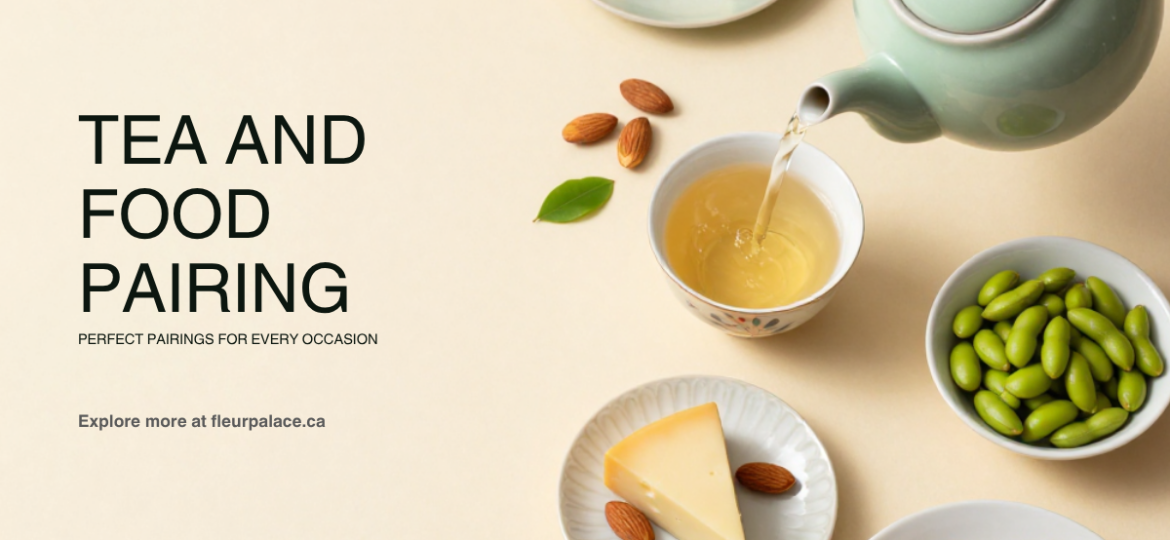
Tea and Food Pairing: A Sommelier’s Guide to Getting It Right
A reliable tea pairing guide doesn’t start with “green tea goes with fish.” It starts with tannin structure. The oxidation level of a tea determines its tannin weight, and tannin weight — like tannin in wine — needs to be matched to the fat and protein content of your food. Get that right first, then look for shared aromatic compounds to create harmony, or deliberate contrast to create interest.
Most tea pairing advice is thin. “Light teas with light food, bold teas with bold food” is a starting point — but it’s the same as saying “drink white wine with fish.” Technically not wrong, but it doesn’t tell you why, and it doesn’t tell you what to do when the pairing falls flat. As a certified tea sommelier based in Oakville, Ontario, I want to give you the actual mechanics behind tea and food pairing so you can reason through any combination yourself, rather than following a chart.
Why the “Light Tea, Light Food” Rule Is Incomplete
The real variable in tea pairing isn’t colour or weight — it’s tannin structure. Tannins are polyphenols that bind to proteins and fats in your mouth. When you sip a high-tannin tea on an empty palate, those tannins bind to the proteins in your saliva, creating a drying, grippy sensation we call astringency. That’s not unpleasant — it’s the same structural element you value in a good Cabernet Sauvignon. But it changes dramatically depending on what you’ve just eaten.
Oxidation drives tannin development. Un-oxidized teas (green, white) are low-tannin and high in delicate aromatic compounds. Fully oxidized teas (black) are high-tannin and structurally robust. Partially oxidized teas (oolong, ranging from roughly 15% to 80% oxidation) sit anywhere on that spectrum. This is the first framework for any tea pairing guide worth using: match the tannin weight to the fat and protein weight of the food.
Tannin, Fat, and the Structural Pairing Rule
Tannins bind preferentially to proteins and fats. This is the mechanism behind milk in tea — the casein proteins in dairy grab the tannins before your palate does, softening the astringency dramatically. The same principle applies to tea and food pairing. A high-tannin black tea served with clotted cream and a buttery scone tastes balanced and round, because the fat intercepts the tannins. The same tea alongside a piece of lean white fish will taste harsh and metallic — there isn’t enough fat or protein to absorb the tannin load.
This also explains why pairing a delicate, low-tannin gyokuro with a rich cream sauce doesn’t work. It’s not about boldness matching boldness — it’s about tannin weight matching fat weight. A fragile green tea disappears behind fat because it has no structural tannin to hold its own. The food dominates and the tea becomes invisible.
In practice: reach for green and white teas with foods that are low in fat and cooked simply — steamed vegetables, light sushi, mild fresh cheeses, rice dishes. Reach for black teas with foods that have significant fat content — pastries, aged cheese, cream-based sauces, charcuterie. And use oolongs as your flexible middle ground, especially with dishes that have moderate fat and some complexity.
Aromatic Bridging: The Technique That Changes Everything
Once you’ve matched tannin to fat, the more refined layer of tea pairing is aromatic bridging — identifying shared volatile compounds between the tea and the food, then exploiting that connection.
Consider bergamot. Both our Organic Cream Earl Grey and our Lavender Earl Grey carry bergamot as their defining aromatic. Bergamot is rich in linalool and limonene — the same volatile compounds found in citrus peel and lavender. Pair either Earl Grey with a lemon curd tart, and linalool from the tea extends the citrus note in the curd past what you’d get from the curd alone. The pairing amplifies both. Try the same Earl Grey with a very sweet chocolate dessert, and the tannin-plus-sugar interaction creates a faint metallic edge — competing rather than bridging.
Our Organic Japan Gyokuro Luxury is one of the clearest examples of aromatic bridging in tea pairing. Shade-growing gyokuro for three weeks before harvest suppresses bitterness and dramatically increases L-theanine and chlorophyll. This creates a pronounced savoury, umami-forward character — seaweed, edamame, fresh green herbs. It pairs remarkably well with brie or camembert: the milky fat softens what little astringency remains while the amino acid richness in the cheese echoes the tea’s own glutamate depth. The umami bridge is real, not metaphorical — both the tea and a well-aged soft cheese contain elevated free glutamates. Serving gyokuro alongside avocado with sea salt, white fish sashimi, or soft scrambled eggs works for the same reason. What it cannot handle: strongly acidic foods (which destroy the delicate vegetal note) or sweet desserts (where umami and sugar genuinely conflict).
Our Ti Kuan Yin Oolong — Iron Goddess of Mercy — is lightly oxidized, sitting at roughly 15–30% on the oxidation spectrum. It develops floral orchid and honey notes alongside a faint stone-fruit sweetness, with moderate tannin that gives it more range than a green tea. The aromatic bridge for Ti Kuan Yin is almond: the tea’s floral compounds echo beautifully in almond-based pastries, Cantonese egg tarts, and almond cookies. In Vancouver’s dim sum restaurants and Toronto’s Chinese bakeries, Ti Kuan Yin is served alongside har gow and egg tarts not by accident — these pairings evolved because they work. At home in Oakville or anywhere across Canada, the same principle holds.
The Contrast Principle (and When to Use It)
Not all tea pairing works through harmony. Contrast is equally valid — and sometimes more interesting. A high-tannin Darjeeling or robust English Breakfast taken between bites of a rich buttery cookie acts as a palate reset: the astringency cuts the fat coating on your tongue, making the next bite taste as good as the first. This is partly why traditional British tea service pairs strong black tea with heavy cream scones — they’re designed to work in alternation, not simultaneously.
The contrast principle also applies to florals. Jasmine tea — like our Jasmine Dragon Tears — is often assumed to pair with sweet floral desserts. In practice, the floral note is vivid precisely because it contrasts with the savoury, slightly salty foods it traditionally accompanies in Cantonese cuisine. Pair jasmine green tea with dim sum, lightly salted crackers, or mild savoury pastries, and the floral element reads as elegant relief. Pair it with a very sweet dessert and the florals amplify into something cloying — too much of the same aromatic direction.
A Note on Steeping for Food Pairing
When you’re pairing tea with food, steep slightly shorter than the standard recommendation — roughly 70–80% of the suggested time. A shorter steep draws less tannin from the leaves, keeping astringency in check so the food can share the spotlight. Full-length steeps are better suited for drinking tea on its own or as a deliberate palate cleanser between courses.
Water temperature matters here too. Green and white teas brewed at the correct lower temperatures (70–80°C) are far more food-friendly than the same leaves over-brewed in boiling water. Over-extracted green tea becomes bitter and astringent — not because the tea is wrong, but because the pairing started at the kettle, not at the table. For detailed brewing guidance across all tea types, see our brewing instructions page.
Tea and food pairing is one of the most rewarding parts of developing a serious tea practice. The principles here — tannin matching fat, aromatic bridging, and deliberate contrast — apply whether you’re in Toronto setting a formal afternoon tea or in Montreal making a simple snack at home. Once you understand the mechanics, the chart becomes unnecessary.
Disclaimer: The information in this article is for general informational and educational purposes only. It is not intended as medical advice and should not be used to diagnose, treat, cure, or prevent any health condition. Always consult a qualified healthcare professional before making changes to your diet or wellness routine.